In today’s B2B world, generating leads is no longer the biggest challenge. Most companies are already doing a good job of attracting interest and creating awareness. The real problem starts after that: turning those leads into a strong, consistent sales pipeline.
This is exactly where many sales teams struggle.
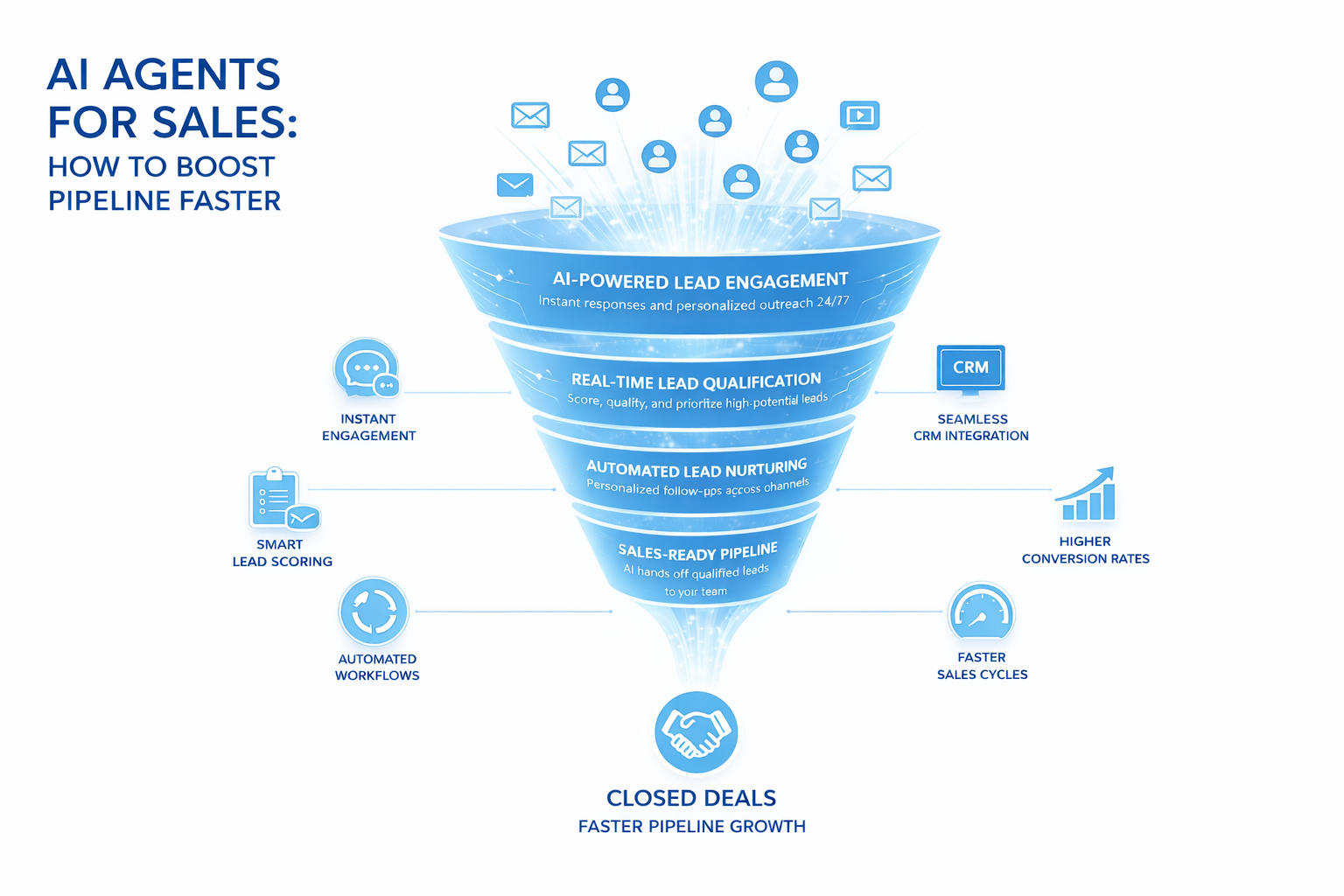
That’s why AI agents are becoming so important. They don’t just support sales teams; they actively help move leads forward. From engaging prospects to qualifying and nurturing them, AI agents make the entire process faster and more efficient.
Table of Contents
ToggleWhat Are AI Agents in Sales?
AI agents in sales are intelligent systems designed to execute tasks across the revenue cycle with minimal human intervention. Unlike traditional automation tools, they don’t just provide insights, they take action.
These agents can:
- Engage website visitors instantly
- Qualify leads based on predefined criteria
- Schedule meetings automatically
- Follow up across multiple channels
- Analyze intent signals and prioritize opportunities
In essence, AI agents function as an always-on extension of the sales development team, ensuring that no opportunity goes unnoticed.
Why Sales Pipelines Break Down
Before understanding how AI agents help, it is important to recognize why pipelines often fail.
Most pipeline leakage happens early, before a sales representative even engages with a lead. Delayed responses, lack of qualification, and inconsistent follow-ups result in missed opportunities.
Speed is one of the most critical factors. When a potential buyer shows interest, timing matters. If engagement is delayed, intent fades, and competitors step in.
Additionally, manual processes create bottlenecks. Sales teams spend hours qualifying leads, sending follow-ups, and managing data, time that could be better spent closing deals.
AI agents address these gaps by removing friction from the earliest stages of the sales cycle.
How AI Agents Accelerate Pipeline Growth
1. Instant Engagement with High-Intent Leads
One of the biggest advantages of AI agents is their ability to respond instantly.
When a prospect visits a website or fills out a form, AI agents can initiate conversations in real time. This immediate engagement captures interest while it is still active, significantly improving conversion rates.
Instead of waiting hours or days for a follow-up, prospects receive instant responses, creating a seamless buying experience.
2. Real-Time Lead Qualification
Not every lead is worth pursuing. In fact, unqualified leads often drain valuable time and resources.
AI agents act as the first layer of qualification. They ask relevant questions, assess intent, and determine whether a lead fits the ideal customer profile.
By filtering out low-quality prospects, sales teams can focus on high-value opportunities. This improves efficiency and increases the likelihood of conversion.
3. Faster Speed-to-Lead
Speed-to-lead is one of the most underestimated drivers of sales success.
AI agents operate 24/7, ensuring that every inquiry receives an immediate response. They eliminate delays, reduce manual intervention, and accelerate the entire engagement process.
This rapid response not only improves customer experience but also increases the chances of securing meetings and advancing deals.
4. Scalable Personalization
Personalization has become essential in modern sales. Buyers expect relevant, contextual interactions tailored to their needs.
However, manual personalization does not scale.
AI agents solve this challenge by adapting messaging based on user behavior, industry, and role. They deliver consistent, personalized experiences across thousands of interactions without increasing headcount.
This allows organizations to maintain quality engagement at scale.
5. Continuous Follow-Ups and Re-Engagement
A significant portion of the pipeline is not lost, it is simply neglected.
Leads often go cold due to missed follow-ups or inconsistent communication. AI agents ensure that this does not happen.
They:
- Send timely follow-ups
- Trigger outreach based on behavioral signals
- Re-engage dormant leads
This continuous engagement keeps prospects active and increases the chances of conversion.
6. Improved Pipeline Visibility and Forecasting
Pipeline management is not just about generating leads, it is about predicting outcomes.
AI agents analyze engagement data, identify patterns, and highlight risks early in the sales process. They help teams understand which deals are progressing and which ones are likely to stall.
This improves forecasting accuracy and enables better decision-making at the leadership level.
The Strategic Shift: From Automation to Execution
Many organizations assume that simply adopting AI tools will lead to better results. However, technology alone does not guarantee success.
AI agents amplify existing processes. If those processes are inefficient, AI will scale inefficiency.
This is why execution matters more than adoption.
Organizations that fail to align their strategy often:
- Implement disconnected tools
- Focus on volume instead of quality
- Ignore alignment between marketing and sales
As a result, they struggle to achieve meaningful outcomes despite investing in AI.
What High-Performing Sales Teams Do Differently
Successful organizations take a structured approach to AI adoption. They focus on strategy, alignment, and continuous optimization.
1. Clear Ideal Customer Profile (ICP)
High-performing teams define their target audience before deploying AI agents. They use intent data to identify high-fit accounts and ensure that engagement is focused on prospects with real potential.
2. Alignment Between Marketing and Sales
AI agents operate across the entire buyer journey. Therefore, alignment between marketing and sales is critical.
Leading organizations ensure consistency in messaging, qualification criteria, and handoff processes. This creates a seamless experience for prospects.
3. Structured Qualification Frameworks
Instead of relying on generic conversations, AI agents follow predefined qualification logic.
This ensures that only relevant, high-intent leads enter the pipeline, improving overall quality and efficiency.
4. Continuous Optimization
Top-performing teams measure success based on outcomes, not activity.
They analyze conversion rates, engagement patterns, and deal progression to refine their AI strategies. This data-driven approach enables continuous improvement.
The Human + AI Collaboration Model
Despite their capabilities, AI agents are not replacing sales teams.
Instead, they complement human efforts by handling repetitive and time-consuming tasks.
AI agents excel at:
- Data processing
- Lead qualification
- Initial engagement
- Follow-ups
Meanwhile, human sales representatives focus on:
- Building relationships
- Handling complex negotiations
- Closing deals
This collaboration creates a more efficient and effective sales process.
The Real Impact on Pipeline Performance
Organizations that effectively implement AI agents often see measurable improvements in pipeline performance.
These include:
- Increased conversion rates
- Faster lead response times
- Higher quality opportunities
- Improved sales productivity
The result is a more predictable and scalable revenue engine.
Common Mistakes to Avoid
While AI agents offer significant advantages, there are common pitfalls that organizations should avoid.
1. Over-Automation
Trying to automate every aspect of the sales process can lead to poor customer experiences. AI should enhance, not replace, human interaction.
2. Lack of Strategy
Deploying AI without a clear strategy often results in fragmented workflows and limited impact.
3. Ignoring Data Quality
AI relies on data. Poor data quality can lead to inaccurate insights and ineffective decision-making.
4. Focusing on Tools Instead of Outcomes
Success should be measured by pipeline growth and revenue, not by the number of tools implemented.
The Future of Sales: Intelligent, Scalable, and Adaptive
The role of AI in sales is evolving rapidly. As technology advances, AI agents will become more sophisticated, enabling deeper insights and more seamless interactions.
However, the core principle will remain the same:
AI is not the advantage, execution is.
Organizations that bring AI agents into their strategy, align their teams, and stay focused on outcomes are more likely to succeed in a competitive market. As a result, they can move faster, respond to opportunities quickly, and perform better overall. In the end, this helps them stay ahead of the competition.
Conclusion
AI agents are transforming how sales pipelines are built, managed, and optimized.
They enable organizations to capture more value from existing demand, eliminate inefficiencies, and maintain continuous engagement with prospects.
More importantly, they shift sales from a reactive process to a proactive, data-driven strategy.
For modern sales teams, the question is no longer whether to adopt AI, but how effectively it can be implemented.
Because in today’s environment, the fastest and most intelligent pipeline wins.
I hope you find the above content helpful. For more such informative content, please visit PangeaGlobalServices.
FAQs:
1. How do AI agents improve sales pipeline growth?
AI agents improve pipeline growth by responding instantly to leads, qualifying prospects in real time, and ensuring consistent follow-ups. This reduces delays and increases conversion rates.
2. What are AI agents in sales?
AI agents in sales are intelligent tools that automate and execute tasks like lead engagement, qualification, follow-ups, and scheduling. They help sales teams work faster and focus on high-value opportunities.
3. Can AI agents replace human sales representatives?
No, AI agents are designed to support, not replace, sales teams. They handle repetitive tasks, allowing sales reps to focus on building relationships, negotiating, and closing deals.
4. What are the key benefits of using AI agents in sales?
Key benefits include faster lead response, better lead qualification, improved productivity, scalable personalization, and more predictable pipeline growth.