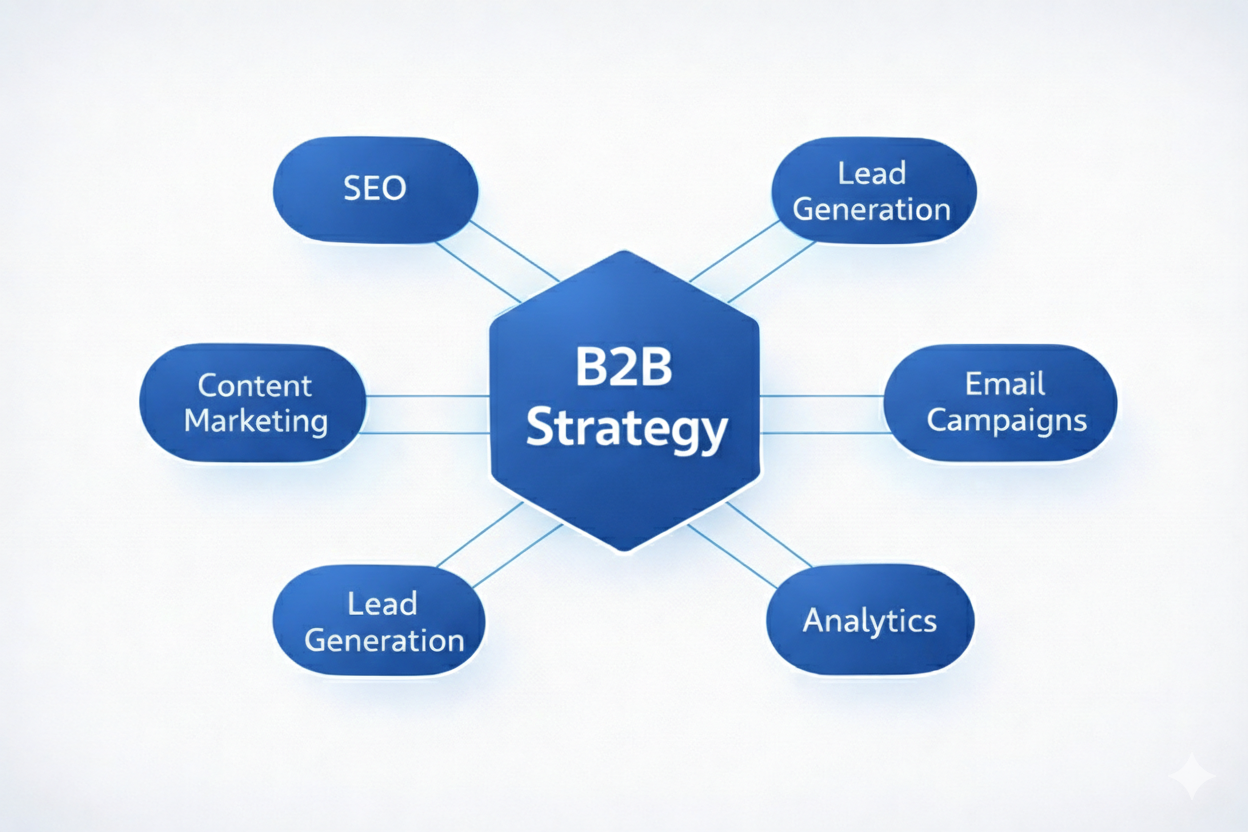
In today’s competitive digital marketplace, a strong B2B Content Strategy is no longer optional, it is essential. Buyers are more informed, decision cycles are longer, and competition is fiercer than ever. As a result, businesses must move beyond random content creation and adopt a structured, data-driven approach.
However, simply producing blogs or social posts is not enough. Instead, companies need a strategic framework that aligns content with business goals, buyer intent, and measurable outcomes. This guide explains how to build a B2B content strategy that drives visibility, authority, and revenue.
Table of Contents
ToggleWhy B2B Content Strategy Matters More Than Ever
B2B buyers conduct extensive research before speaking to a sales representative. In fact, most of the decision-making journey happens online. Therefore, your content must educate, build trust, and demonstrate expertise long before a direct conversation occurs.
Moreover, B2B purchases typically involve multiple stakeholders. Consequently, your messaging must address diverse concerns such as ROI, implementation, risk, and scalability. A well-defined B2B Content Strategy ensures that every piece of content serves a purpose and speaks to the right audience at the right stage.
Without a strategy, businesses often create disconnected content that fails to convert. With a strategy, content becomes a predictable growth engine.
Step 1 – Define Clear Business Objectives
Before creating any content, you must identify your primary goals. For example:
- Are you aiming to generate qualified leads?
- Do you want to improve brand authority?
- Is customer retention your priority?
- Are you entering a new market?
Each objective requires a different content approach. For instance, thought leadership articles may build authority, whereas case studies can directly support sales conversations. Therefore, aligning content with measurable KPIs is the foundation of an effective B2B Content Strategy.
Step 2 – Understand Your Target Audience Deeply
Successful B2B marketing begins with clarity about your audience. Instead of targeting “businesses,” define specific buyer personas. Consider:
- Job roles (CMO, CTO, Procurement Manager)
- Industry challenges
- Decision-making authority
- Budget influence
- Pain points and goals
Furthermore, remember that B2B audiences value data, logic, and proof. Therefore, your content must provide actionable insights rather than generic advice.
Additionally, mapping content to different stages of the buyer journey, awareness, consideration, and decision, ensures relevance throughout the funnel.
Step 3 – Build a Strong Content Foundation with SEO
Search visibility plays a critical role in any B2B Content Strategy. After all, your audience is actively searching for solutions online. Therefore, keyword research is essential.
Start by identifying:
- Primary keywords (e.g., B2B Content Strategy)
- Secondary keywords
- Long-tail search queries
- Industry-specific terms
However, SEO is not just about keywords. It also includes:
- Clear site structure
- Optimized meta descriptions
- Internal linking
- High-quality backlinks
- Fast loading speed
Moreover, search engines prioritize authoritative and original content. Consequently, producing in-depth, research-backed content significantly improves rankings.
Step 4 – Create High-Value Content Formats
Different formats serve different purposes. Therefore, a diversified content mix strengthens your strategy.
- Blog Articles
Blogs help attract organic traffic and educate prospects. They are particularly effective for addressing common industry questions.
- Whitepapers and eBooks
These assets provide in-depth knowledge and are ideal for lead generation. Additionally, they position your brand as a thought leader.
- Case Studies
Because B2B buyers seek proof, case studies demonstrate real-world success. They directly support sales enablement.
- Webinars and Events
Interactive formats allow deeper engagement. Furthermore, they build trust through live discussions and Q&A sessions.
- Email Campaigns
Email nurtures prospects over time. When combined with segmented messaging, it becomes a powerful conversion tool.
By integrating multiple formats, your B2B Content Strategy remains dynamic and effective.
Step 5 – Align Content with the Sales Funnel
Content should guide prospects from awareness to decision.
- Awareness Stage
At this stage, buyers recognize a problem. Therefore, educational blogs, industry reports, and thought leadership pieces work best.
- Consideration Stage
Now buyers compare solutions. Consequently, comparison guides, expert insights, and webinars are highly effective.
- Decision Stage
Here, buyers evaluate vendors. As a result, product demos, testimonials, and case studies become critical.
When content aligns with the buyer journey, conversion rates improve significantly.
Step 6 – Focus on Quality Over Quantity
Publishing frequently is helpful. However, quality matters more than volume. A single well-researched article can outperform multiple generic posts.
Moreover, B2B audiences expect depth and clarity. Therefore, your content should:
- Offer data-backed insights
- Include expert opinions
- Present clear solutions
- Avoid fluff
Additionally, maintaining a consistent brand voice builds recognition and trust over time.
Step 7 – Distribute Content Strategically
Even the best content fails without distribution. Therefore, promotion is as important as creation.
Key distribution channels include:
- LinkedIn (highly effective for B2B)
- Industry newsletters
- Email campaigns
- Paid advertising
- Partner collaborations
Furthermore, repurposing content increases reach. For example, a webinar can become blog posts, short videos, and social media snippets.
Thus, distribution maximizes the impact of your B2B Content Strategy.
Step 8 – Measure Performance and Optimize
Data-driven decision-making strengthens long-term success. Therefore, track key metrics such as:
- Organic traffic
- Engagement rates
- Lead conversions
- Content downloads
- Time on page
However, analysis should go beyond surface metrics. For example, if traffic increases but leads remain low, your content may lack strong CTAs.
Regular audits help refine your strategy. Consequently, continuous optimization ensures sustainable growth.
Step 9 – Leverage AI and Automation Wisely
Artificial intelligence is transforming content marketing. AI tools can assist with:
- Topic research
- Content outlines
- Personalization
- Predictive analytics
Nevertheless, human expertise remains crucial. While AI improves efficiency, strategic direction and creativity still require human insight.
Therefore, combining AI capabilities with strategic thinking enhances your overall B2B Content Strategy.
Step 10 – Build Authority Through Thought Leadership
In competitive industries, differentiation is essential. Therefore, thought leadership plays a vital role.
Publishing original research, expert opinions, and trend analyses helps your brand stand out. Additionally, executive insights and founder perspectives build credibility.
Over time, authoritative content attracts backlinks, media attention, and industry recognition.
Common Mistakes to Avoid
Even strong businesses make strategic errors. Therefore, avoid these pitfalls:
- Creating content without defined goals
- Ignoring SEO fundamentals
- Over-promoting instead of educating
- Failing to measure performance
- Producing inconsistent messaging
Instead, focus on clarity, consistency, and customer value.
The Future of B2B Content Strategy
The future of B2B Content Strategy is increasingly personalized, data-driven, and AI-enhanced. Buyers expect tailored experiences and instant access to relevant insights.
Moreover, video content, interactive tools, and conversational AI will continue to shape engagement. However, authenticity will remain a key differentiator.
Therefore, businesses that combine technology with strategic storytelling will lead the market.
Conclusion
A successful B2B Content Strategy does not happen by accident. It requires research, planning, execution, and continuous improvement. However, when done correctly, it becomes a powerful engine for growth.
By aligning content with business objectives, understanding your audience, optimizing for search, and measuring performance, you can transform content into a measurable revenue driver.
Ultimately, B2B content is not just about publishing, it is about building trust, delivering value, and guiding buyers toward confident decisions.
I hope you find the above content helpful. For more such informative content, please visit PangeaGlobalServices.
FAQs:
1. Why is B2B Content Strategy important for lead generation?
A strong B2B Content Strategy helps attract high-intent prospects through valuable, search-optimized content. Additionally, it nurtures leads with relevant insights, case studies, and thought leadership, which ultimately increases conversions and shortens the sales cycle.
2. How is B2B Content Strategy different from B2C?
Unlike B2C marketing, B2B Content Strategy targets multiple stakeholders and longer decision cycles. Therefore, it emphasizes data-driven insights, ROI-focused messaging, and in-depth educational content rather than emotional or impulse-driven messaging.
3. What are the key elements of a successful B2B Content Strategy?
An effective B2B Content Strategy includes clear business goals, defined buyer personas, SEO optimization, high-quality content formats, consistent distribution, and performance tracking. Moreover, continuous optimization ensures long-term growth and measurable results.
4. What is a B2B Content Strategy?
A B2B Content Strategy is a structured plan for creating, publishing, and distributing content that targets business decision-makers. It focuses on educating prospects, building trust, and guiding them through the buying journey to generate qualified leads and revenue.