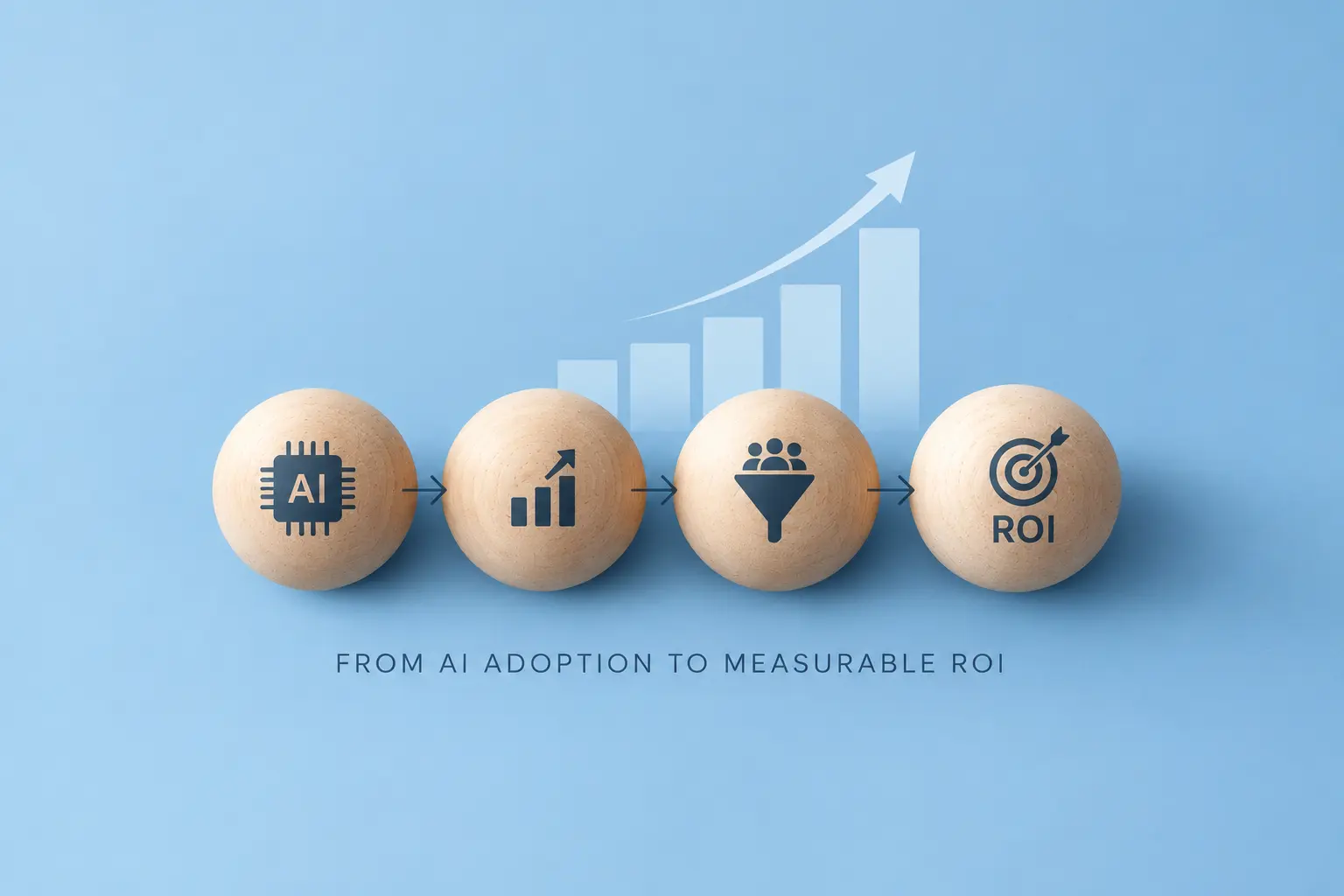
B2B marketing teams are using AI for everything from drafting content to scoring leads and automating campaigns. The tools work, and the work gets done faster. But faster isn’t the same as better for the business.
That’s the measurement gap. Hours saved are easy to count, while revenue impact is much harder to pin down. To prove AI marketing ROI, you need to connect the tools you use to the results leadership actually cares about.
Table of Contents
ToggleWhy AI Marketing ROI Is Hard to Measure
The first problem is that many teams measure output instead of outcomes. Producing 50 AI-assisted assets sounds impressive, but it says nothing about whether those assets generated pipeline. The second is the length of B2B buying journeys. Deals involve many stakeholders and touchpoints over several months, so tracing a closed deal back to a single AI-assisted email is rarely straightforward.
Costs are another blind spot. The subscription fee is only part of the bill, because integration, training, and human review all add up. Finally, AI may contribute to a result without being its only cause, which makes credit hard to assign. None of this means ROI can’t be measured. It means you have to be deliberate about how.
Productivity Metrics vs. Business Impact Metrics
Both kinds of metrics matter, but they answer different questions. Productivity metrics, such as content production time, tasks automated, hours saved, campaign setup time, and the number of AI-assisted assets, show whether AI is working efficiently. Business impact metrics, such as qualified leads, cost per qualified lead, sales opportunities, pipeline contribution, revenue, and customer acquisition cost, show whether that efficiency is turning into value.
The strongest reports connect the two. For example: “We saved 20 hours a month and reinvested that time in campaigns that lowered our cost per qualified lead.” That one sentence tells a story leadership can act on.
Five KPIs Worth Tracking
Start with cost per qualified lead. This tells you whether AI-assisted campaigns bring in suitable leads at a lower cost, so count qualified leads rather than any sign-up. Next, look at the lead-to-opportunity conversion rate, which shows whether more of those leads become real sales conversations. It’s a good signal of lead quality rather than just volume.
Pipeline contribution is the value of sales opportunities linked to AI-assisted campaigns. It’s useful, but remember that pipeline isn’t revenue. A big pipeline number only counts once deals close. Campaign ROI asks whether the financial return justifies the total investment in a campaign. Finally, customer acquisition cost (CAC) shows whether the cost of winning a customer is changing after you introduce AI. Because B2B sales cycles are long, give this one time before drawing conclusions.
How to Calculate AI Marketing ROI
The basic formula is simple: ROI (%) = (Benefits − Total Costs) ÷ Total Costs × 100.
Benefits can include incremental gross profit and cost savings you can defend with data. Total costs should cover software, integration, training, human oversight, and day-to-day operating expenses.
Here’s an illustrative example, not an industry benchmark. Say an AI initiative produces ₹5 lakh in measurable benefits and costs ₹2 lakh in total. The ROI is (5 − 2) ÷ 2 × 100, which gives 150%. Two cautions apply: don’t count the same benefit twice, and don’t treat all influenced pipelines as realized revenue.
A Practical Framework to Prove It
You don’t need a complicated setup. Begin by establishing a baseline: record your current costs, conversion rates, campaign performance, and time spent before changing anything. Then pick one use case, such as lead scoring, campaign personalization, or data enrichment, so you can isolate the effect of AI.
Next, set your targets upfront. Decide what success looks like before you switch AI on, not after the results arrive. Where possible, run a controlled test by comparing AI-assisted activity against a control group or a similar baseline period. Throughout, track the full cost, including review time and ongoing maintenance. Lastly, look downstream. Follow lead quality, opportunity progression, and revenue over a period that fits your sales cycle, rather than judging the experiment by its first month.
Common Mistakes That Distort the Numbers
The most common error is assuming correlation proves causation: a campaign performed well, AI was involved, so AI must have caused it. Teams also tend to ignore implementation and review costs, celebrate lead quantity without checking quality, or compare campaigns with different audiences and budgets. Another frequent mistake is expecting instant revenue from a long sales cycle. And reporting “AI-influenced revenue” without a clear attribution method can quietly inflate results. Any of these can make performance look better, or worse, than it really is.
Conclusion
AI success in marketing shouldn’t be judged by adoption alone. Look at efficiency, lead quality, pipeline progression, and financial impact together. Before you scale anything, choose one use case, set a baseline, measure total costs, and evaluate real outcomes.
I hope you find the above content helpful. For more such informative content, please visit PangeaGlobalServices.
FAQs
1. What is AI marketing ROI?
It’s the financial return from AI-driven marketing activity compared with the total cost of running it.
2. How do you measure the ROI of AI marketing tools?
Compare benefits, such as incremental profit and defensible cost savings, against total costs, using a baseline or control group where possible.
3. Which KPIs should B2B marketers track?
Cost per qualified lead, lead-to-opportunity conversion, pipeline contribution, campaign ROI, and CAC.
4. How long does it take to see returns?
It depends on your sales cycle. Efficiency gains can show up quickly, but revenue impact in B2B often takes months.