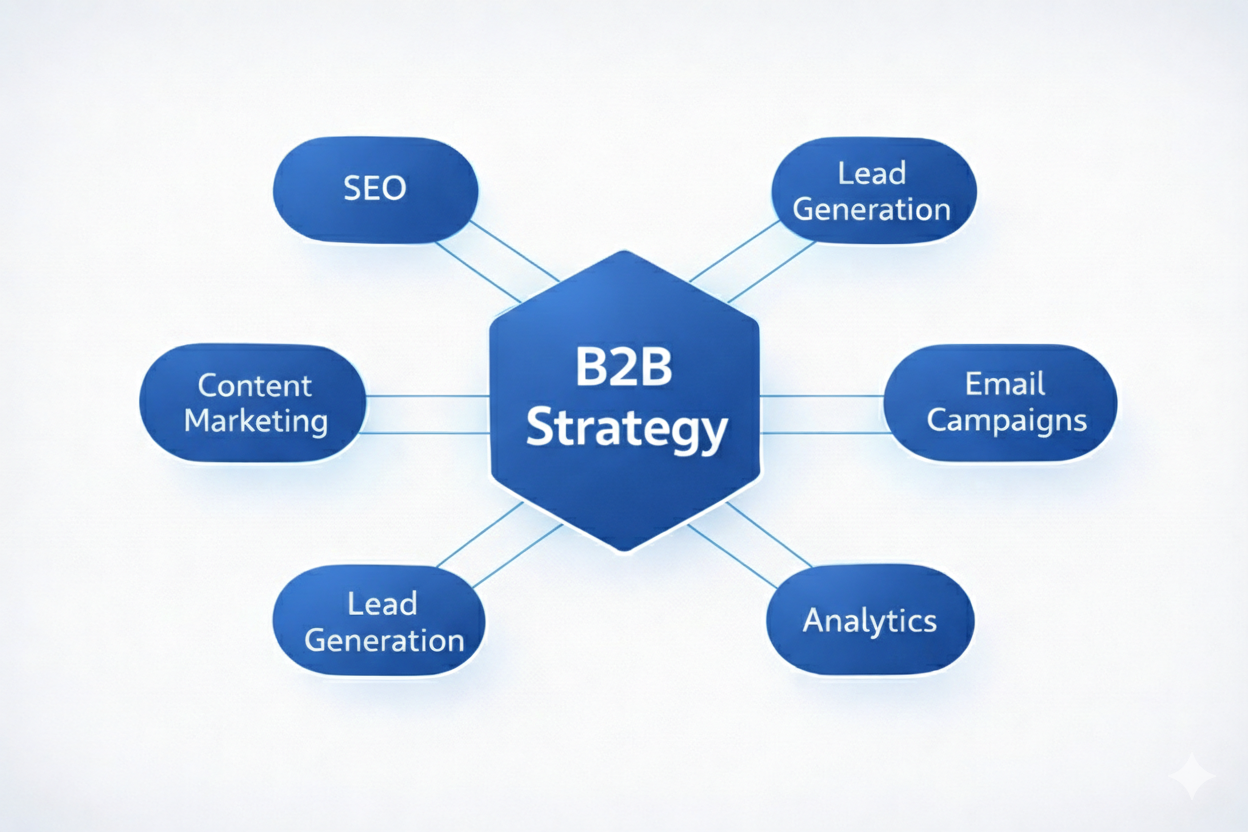
In today’s competitive business environment, tracking performance is no longer optional. For B2B organizations, clearly defined B2B KPIs (Key Performance Indicators) help teams measure progress, optimize strategies, and accelerate revenue growth. Without the right KPIs, companies risk operating on assumptions instead of data-driven decisions.
This comprehensive guide explains the most important B2B KPIs in 2026, how to choose the right ones, and how they directly impact marketing, sales, and long-term profitability.
Table of Contents
ToggleWhat Are B2B KPIs?
B2B KPIs are measurable values that indicate how effectively a business achieves its strategic objectives. Unlike general metrics, KPIs directly align with core business goals such as revenue growth, customer acquisition, retention, and operational efficiency.
For example:
- Website traffic is a metric.
- Lead conversion rate is a KPI because it shows how traffic contributes to revenue potential.
KPIs provide clarity, accountability, and direction across departments.
Why B2B KPIs Matter More Than Ever
In B2B industries, for example, sales cycles are longer, decision-making units are larger, and contracts typically involve higher value. As a result, the overall buying process becomes more complex and layered. Because of this complexity, organizations must rely on clearly defined KPIs to maintain visibility and control. Therefore, consistent KPI tracking becomes essential for sustainable growth and accurate forecasting.
Effective B2B KPIs help organizations:
- Align marketing and sales teams
- Optimize budget allocation
- Identify pipeline bottlenecks
- Forecast revenue accurately
- Improve customer retention
When teams monitor the right indicators consistently, they move from reactive problem-solving to proactive strategy execution.
Core Categories of B2B KPIs
Successful B2B companies organize KPIs into three major categories:
- Marketing KPIs
- Sales KPIs
- Customer & Financial KPIs
Each category answers a critical business question.
Marketing KPIs That Drive Demand
Marketing KPIs measure how effectively your brand generates awareness and qualified leads.
1. Marketing Qualified Leads (MQLs)
MQLs represent prospects who show enough interest to move closer to a sales conversation. Tracking MQLs helps evaluate content performance and targeting accuracy.
2. Lead Conversion Rate
This KPI measures the percentage of visitors who complete a desired action, such as downloading a whitepaper or booking a demo. A strong conversion rate indicates messaging clarity and audience relevance.
3. Cost Per Lead (CPL)
CPL calculates how much you spend to generate each lead. Lower CPL combined with high-quality leads signals efficient marketing spend.
4. Website Conversion Rate
Your website acts as a digital storefront. Monitoring how effectively visitors turn into inquiries or sign-ups reveals the strength of your funnel.
5. Pipeline Contribution
Marketing should contribute measurable value to the sales pipeline. This KPI tracks how much revenue opportunity marketing generates.
Sales KPIs That Impact Revenue
Sales KPIs reveal how effectively your team converts opportunities into closed deals.
6. Sales Qualified Leads (SQLs)
SQLs are leads that sales teams verify as ready for direct engagement. Monitoring SQL volume shows alignment between marketing and sales.
7. Win Rate
Win rate measures the percentage of opportunities converted into customers. Increasing this KPI improves revenue without expanding lead volume.
8. Average Deal Size
Tracking deal size helps identify upselling opportunities and pricing strategy effectiveness.
9. Sales Cycle Length
This KPI measures the time required to close a deal. Shorter cycles improve cash flow and operational efficiency.
10. Customer Acquisition Cost (CAC)
CAC calculates the total cost required to acquire a new customer. When CAC decreases while revenue increases, profitability improves.
Customer & Financial KPIs for Sustainable Growth
Long-term success depends on retention and customer value, not just acquisition.
11. Customer Lifetime Value (CLV)
CLV estimates the total revenue generated from a customer relationship. Increasing CLV strengthens profitability and reduces dependency on constant acquisition.
12. Net Revenue Retention (NRR)
NRR measures how much revenue existing customers continue generating, including expansions and renewals. High NRR indicates strong product-market fit.
13. Churn Rate
Churn tracks the percentage of customers who stop doing business with you. Reducing churn directly improves revenue stability.
14. Return on Investment (ROI)
ROI evaluates how much revenue your campaigns generate compared to the cost invested. It validates strategy effectiveness.
How to Choose the Right B2B KPIs
Not every metric deserves dashboard space. To select effective B2B KPIs:
- Align KPIs with business objectives
- Focus on measurable outcomes tied to revenue
- Balance leading indicators (predict future growth) and lagging indicators (measure past results)
- Limit dashboards to 7–10 high-impact KPIs
- Review performance monthly or quarterly
Clarity and consistency drive better results than tracking excessive data points.
Common B2B KPI Mistakes to Avoid
1. Tracking Vanity Metrics
Metrics like social followers or impressions may look impressive but often lack revenue connection. Focus on conversion and retention metrics instead.
2. Ignoring Cross-Team Alignment
Marketing, sales, and customer success teams must agree on KPI definitions. Misalignment leads to inaccurate reporting and missed opportunities.
3. Setting Unrealistic Benchmarks
Targets should challenge teams but remain achievable. Unrealistic goals reduce morale and distort strategy.
4. Failing to Adjust KPIs
As markets evolve, so should your KPIs. Regular evaluation ensures relevance.
Building a KPI Dashboard That Works
An effective KPI dashboard includes:
- Lead generation indicators
- Pipeline and sales performance data
- Revenue and retention metrics
- Trend comparisons over time
In today’s data-driven environment, modern dashboards integrate CRM, marketing automation, and analytics platforms to provide real-time visibility. As a result, teams can monitor performance instantly and respond to emerging trends more effectively. Moreover, this integration ensures that data flows seamlessly across departments. Consequently, decision-makers gain clearer insights and can act with greater confidence.
To ensure consistent performance, leadership teams should review KPIs weekly for tactical adjustments. In addition, they should evaluate them monthly for broader strategic planning. By doing so, organizations can respond quickly to short-term challenges while simultaneously aligning long-term business goals. Ultimately, this structured review process strengthens decision-making and drives sustainable growth.
The Future of B2B KPIs in 2026
The future of B2B KPIs is increasingly predictive and AI-driven. As technology continues to evolve, companies now rely more heavily on advanced analytics to forecast pipeline performance. In addition, they use intelligent systems to detect churn risks before they escalate. Furthermore, AI-powered insights help identify upselling and cross-selling opportunities with greater accuracy. As a result, businesses can shift from reactive reporting to proactive growth strategies.
Emerging trends include:
- Predictive revenue modeling
- AI-powered lead scoring
- Multi-touch attribution tracking
- Customer health scoring systems
These innovations shift KPI analysis from reactive reporting to proactive decision-making.
Conclusion
B2B KPIs serve as the backbone of sustainable business growth. When aligned with strategy and monitored consistently, they provide clarity, direction, and accountability.
In 2026, companies that leverage data intelligently consistently outperform competitors who rely on intuition alone. As a result, data-driven decision-making has become a critical competitive advantage. By focusing on the right marketing, sales, and financial KPIs, organizations can not only optimize performance but also increase profitability. Moreover, well-defined KPIs help teams align their efforts toward measurable goals. Ultimately, this strategic focus enables businesses to build stronger, long-term customer relationships while sustaining scalable growth.
The key is simple: measure what matters, act on insights, and refine continuously.
FAQs
1. What are B2B KPIs?
B2B KPIs (Key Performance Indicators) are measurable metrics that help businesses evaluate performance against strategic goals. They track areas like lead generation, sales efficiency, customer retention, and revenue growth.
2. Why are B2B KPIs important for business growth?
B2B KPIs provide data-driven insights that improve decision-making, align marketing and sales teams, and optimize budget allocation. Without KPIs, companies struggle to measure progress or identify performance gaps.
3. What are the most important B2B KPIs in 2026?
Some of the most important B2B KPIs include Marketing Qualified Leads (MQLs), Sales Qualified Leads (SQLs), Customer Acquisition Cost (CAC), Customer Lifetime Value (CLV), Win Rate, and Net Revenue Retention (NRR).
4. How often should B2B KPIs be reviewed?
Most companies review core B2B KPIs weekly for tactical adjustments and monthly or quarterly for strategic evaluation. Regular reviews help teams stay aligned and respond quickly to performance trends.
5. What is the difference between a KPI and a metric in B2B?
A metric measures general data points, such as website traffic or email opens. A KPI, however, directly connects to strategic business outcomes like revenue growth or customer retention.