Most enterprises have already run an AI pilot. A chatbot answers common questions, a model flags suspicious transactions, a tool extracts data from invoices. Each works on its own. Yet the underlying process, whether onboarding a client, settling a claim, or reviewing a contract, is still slow, manual, and full of handoffs.
The problem is rarely the quality of the AI. It’s the architecture. Real business processes involve documents, data, exceptions, and decisions across several teams and systems. One general-purpose model asked to handle all of that eventually buckled. Multi-agent AI is the architectural answer.
Table of Contents
ToggleWhere single-agent AI runs out of road
A single-agent system puts one model in charge of everything: reading inputs, reasoning, deciding, and acting. That’s fine for a contained task such as summarizing a document or answering an FAQ. As responsibilities pile up, the cracks show:
- Context overload. One model has to hold every rule, record, and instruction at once, which hurts accuracy and raises the risk of hallucination.
- Slow, sequential execution. Steps that could run side by side wait in line.
- Single point of failure. If the agent stalls or errs, the whole workflow stops.
- Shallow expertise. A generalist handles many tasks adequately but few exceptionally, which matters in compliance, finance, or healthcare.
- Expensive change. Adding a capability often means re-engineering the entire system.
The result is what many leaders now call AI silos: pockets of automation that speed up one step while the end-to-end process stays fragmented.
What multi-agent orchestration actually is
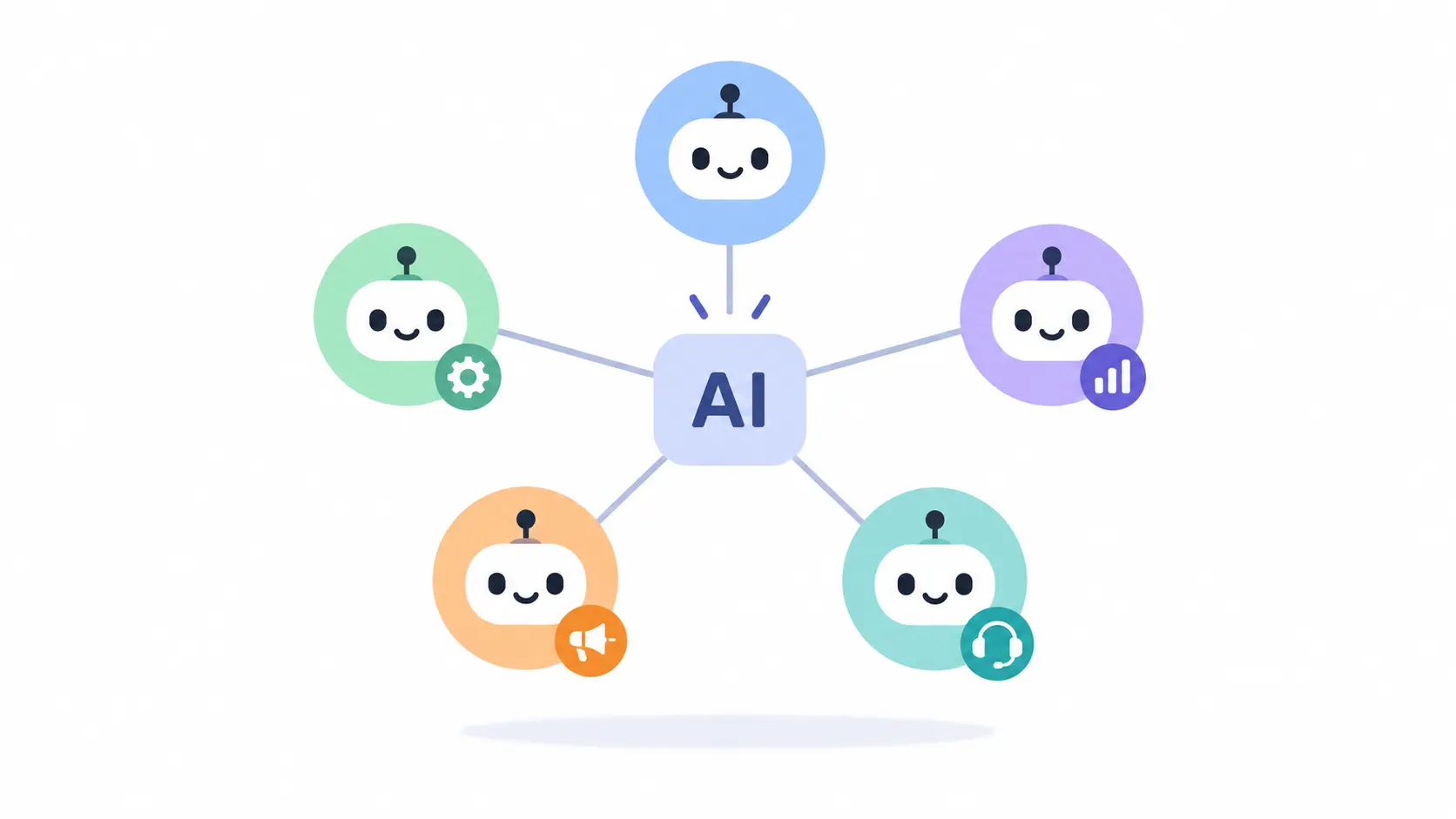
In a multi-agent system, several specialized AI agents work toward one shared goal. An orchestrator coordinates them. It breaks the goal into subtasks, assigns each to the best-suited agent, tracks progress, manages dependencies, and assembles the final result.
Think of an orchestra. Each section has its own expertise, but without a conductor you get noise instead of music. The orchestrator is the conductor, the agents are the sections, and the workflow is the score.
A well-designed system has four building blocks:
- Orchestrator. Holds the process map, routes work, and decides when to escalate to a person.
- Specialized agents. Purpose-built units, such as document intake, compliance checking, risk scoring, or customer communication.
- Shared context. A common memory layer so each agent receives the full picture instead of starting from zero at every handoff.
- Governance. The rules defining what each agent may access, what it may do, and when a human must step in.
Why it matters for the business
- Scale by adding, not rebuilding. Need a new capability? Add a specialized agent instead of overloading an existing model. Workflows grow without degrading the ones already running.
- Speed through parallel work. Take an insurance claim. Document intake, fraud screening, policy verification, and customer updates don’t all need to wait on each other. Agents can run them concurrently while the orchestrator enforces the right order where dependencies exist.
- Resilience by design. If one agent fails or confidence drops, the orchestrator can reroute to a backup agent or hand off to a human reviewer. Fault tolerance is built into the structure.
- Domain depth. Agents can be tuned to the vocabulary, policies, and logic of a specific function, which is where generic models tend to underperform.
- Better decisions. Agents share information in real time, so decisions draw on a fuller picture than any single model would have.
- Works with the systems you already have. Connector and transformation agents can sit between modern AI and legacy ERPs or systems of record, translating data and formats at runtime. This often avoids a costly rip-and-replace modernization.
Where it’s already paying off
- Financial services – Client onboarding that once took weeks of manual KYC checks and sequential review queues can be restructured so ingestion, identity verification, compliance screening, and account setup run as one coordinated flow.
- Insurance – Claims intake, fraud signals, and liability assessment handled in parallel, with exceptions routed to adjusters.
- Supply chain and logistics – Separate agents track inventory, optimize routes, and manage warehouse activity at the same time, then adjust as conditions change.
- Manufacturing – Agents monitor equipment, predict failures, and trigger maintenance before downtime hits.
- Healthcare – Coordinated agents support care planning and documentation while keeping sensitive data inside defined boundaries.
- Legal and procurement – Contract review, clause checks, and approval routing handled end to end.
Governance is not optional
Autonomous agents expand your security and compliance surface. Prompt injection, unintended data exposure, and policy-violating outputs are real risks. Strong governance typically includes:
- Role-based access for each agent, ideally bound to the permissions of the user it acts for
- Limits on which systems, data, and actions agents can touch
- Human-in-the-loop checkpoints for high-risk or low-confidence decisions
- Audit logs of every agent action and output
- Policy checks before outputs move downstream
- Continuous monitoring for drift and anomalies
A useful principle is progressive governance. Start agents with tight limits, then widen their autonomy as they prove reliable. Trust should follow demonstrated performance.
How to adopt it without the pilot-to-production gap
Many AI initiatives produce an impressive demo and then stall. A grounded approach avoids that:
- Pick one workflow with clear pain. Choose a process that is high-volume, document-heavy, and measurable.
- Define KPIs before you build. Typical measures are cycle time, straight-through processing rate, cost per transaction, error rate, and audit visibility.
- Design roles and handoffs. Map which agents do what, what context they share, and where humans review.
- Pilot with guardrails. Validate in a controlled setting with human oversight on.
- Instrument everything. Monitor performance and behavior in production, not just in testing.
- Expand deliberately. Add agents and workflows as results and governance mature.
Single-agent or multi-agent: which do you need?
If your task is simple, self-contained, and centrally controlled, a single agent may be all you need. If your process crosses teams and systems, depends on specialized knowledge, handles exceptions, or must keep running when parts fail, a multi-agent architecture is the stronger foundation.
Build collaborative intelligence, not bigger models
The next stage of enterprise AI won’t come from asking one model to do more. It will come from designing systems where specialized agents collaborate under clear rules, with people involved where judgment matters.
FAQs
1. What is the difference between single-agent and multi-agent AI?
A single-agent system relies on one model to handle every task. A multi-agent system distributes work across specialized agents that collaborate under an orchestrator.
2. Is multi-agent AI fully autonomous?
No. Most enterprise designs keep humans in the loop for high-risk, low-confidence, or policy-sensitive decisions.
3. Can it work with our legacy systems?
Yes. Connector and transformation agents can bridge older systems and modern AI, so you can add capability without replacing your core platforms.
4. What are the main challenges?
Coordinating agents, keeping context consistent across handoffs, controlling access, and maintaining visibility into what agents are doing. Good architecture, governance, and monitoring address each of these.
5. How do we measure success?
Set KPIs up front: cycle time, straight-through processing, cost per transaction, error rates, and audit readiness.
6. Which frameworks can we build on?
Common options include LangGraph, Microsoft AutoGen, CrewAI, and OpenAI’s Swarm. The right choice depends on your stack, security requirements, and use case.