Artificial intelligence is reshaping the way organisations approach research, especially in fields that rely heavily on data interpretation and human behavior. Among these, qualitative research stands out as a discipline deeply rooted in understanding emotions, motivations, and context. While AI offers remarkable advantages in processing and organising data, it also raises an important question: can machines truly understand human experiences?
The growing adoption of AI in qualitative research signals a shift toward faster, more scalable methodologies. However, it also highlights the need to strike a careful balance between technological efficiency and human judgment. As organizations navigate this transformation, the goal is not to replace human researchers but to enhance their capabilities through intelligent collaboration.
Table of Contents
ToggleThe Expanding Role of AI in Qualitative Research
Qualitative research traditionally involves time-intensive processes such as coding interview transcripts, identifying themes, and interpreting responses. These tasks require attention to detail and often demand significant human effort. AI tools have begun to streamline many of these processes by automating repetitive, labour-intensive tasks.
Modern AI systems can analyse large volumes of unstructured data, including open-ended survey responses, interview transcripts, and social media conversations. They can quickly categorise responses, detect sentiment, and identify recurring patterns across datasets. This ability to process information at scale has transformed the speed at which insights can be generated.
For example, what once took weeks of manual coding can now be completed in minutes with AI-powered tools. This efficiency allows researchers to shift their focus from data preparation to deeper analysis and strategic thinking.
Key Advantages of AI-Driven Research
The integration of AI into qualitative research offers several clear benefits that make it an attractive tool for organizations:
- Speed and Efficiency
AI significantly reduces the time required to process large datasets. By automating repetitive tasks such as coding and classification, it enables researchers to work faster without compromising output volume. - Scalability
Traditional qualitative research often limits sample sizes due to resource constraints. AI removes this limitation by enabling the analysis of thousands of responses simultaneously, expanding the scope of research. - Consistency in Analysis
Human researchers may interpret data differently based on individual perspectives. AI applies consistent rules across datasets, reducing variability and improving standardization in coding. - Pattern Recognition
AI can detect trends and connections that may not be immediately visible to human analysts. This capability helps uncover insights that might otherwise go unnoticed.
These advantages demonstrate why AI is increasingly becoming a core component of modern research strategies. However, they also reveal an important limitation: efficiency does not always equate to understanding.
The Limits of Artificial Intelligence
Despite its strengths, AI faces significant challenges when it comes to interpreting human behavior. Qualitative research is not just about identifying patterns, it is about understanding meaning. This is where AI often falls short.
Language is complex, nuanced, and deeply influenced by context. Sarcasm, cultural references, emotional undertones, and implicit meanings are difficult for AI to interpret accurately. For instance, a sarcastic remark may be incorrectly categorized as positive, leading to flawed conclusions.
Moreover, AI operates on probabilistic models rather than lived experience. It predicts language patterns based on data but does not truly “understand” the context behind them. This limitation raises concerns about the reliability and authenticity of AI-generated insights.
Another challenge lies in data interpretation. AI can summarize and categorize information, but it often struggles to generate deep, theory-driven insights. In some cases, AI outputs may appear accurate on the surface but lack a strong connection to the underlying data.
These limitations highlight the importance of human involvement in the research process.
Why Human Insight Remains Essential
Human researchers bring qualities that AI cannot replicate, empathy, intuition, cultural awareness, and critical thinking. These attributes are central to qualitative research, where understanding human experiences is the primary objective.
Unlike AI, humans can interpret tone, recognize subtle cues, and contextualize responses within broader social and cultural frameworks. They can also adapt their analysis as new insights emerge, making qualitative research an iterative and dynamic process.
Human judgment also plays a crucial role in validating findings. Researchers must assess whether AI-generated outputs accurately reflect the data and whether the conclusions drawn are meaningful and relevant. Without this oversight, there is a risk of misinterpretation or oversimplification.
In essence, while AI can assist with analysis, it cannot replace the human ability to derive meaning from complex, nuanced data.
The Case for Human-AI Collaboration
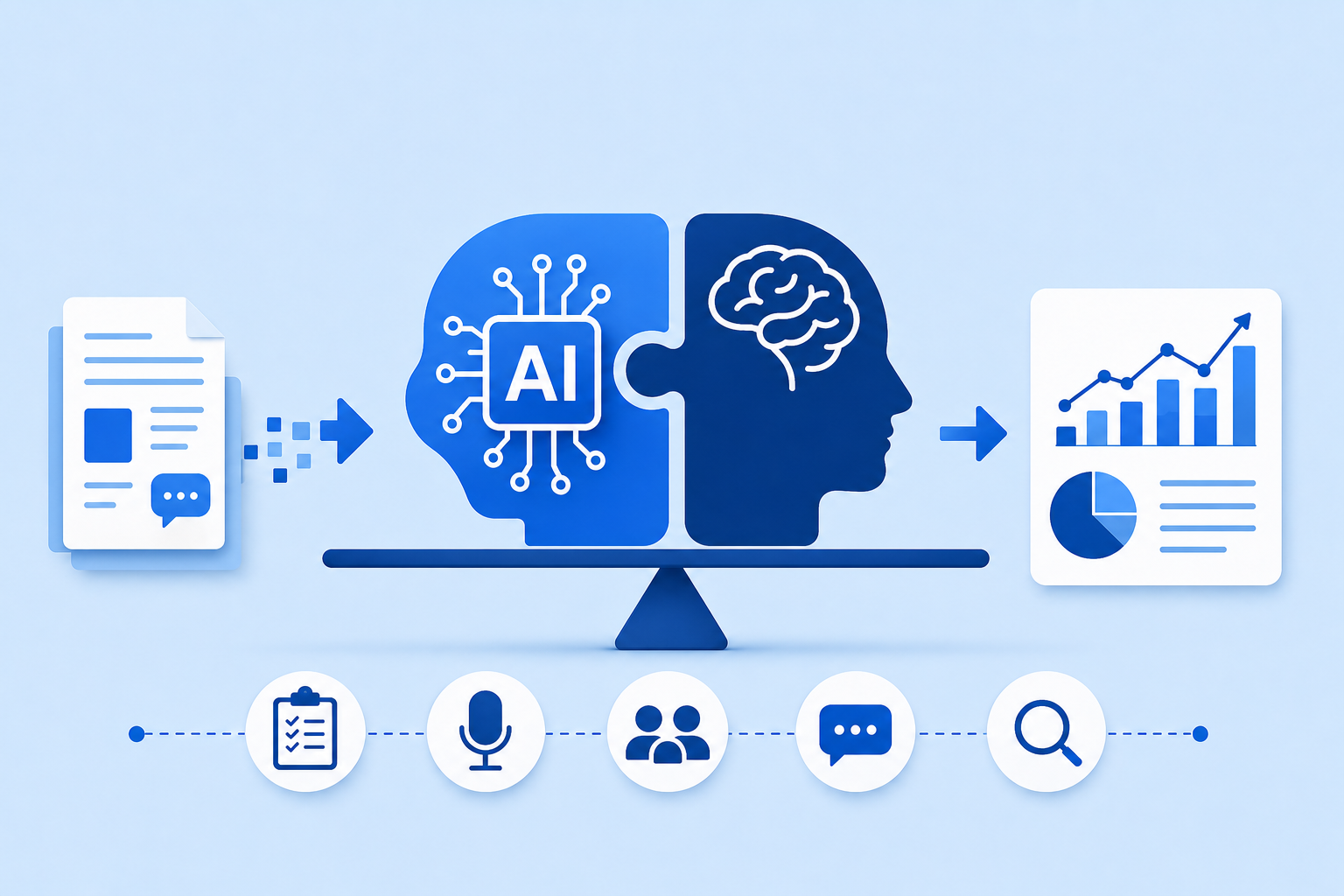
Rather than viewing AI as a replacement for human researchers, organizations are increasingly adopting a collaborative approach. In this model, AI handles data-heavy tasks while humans focus on interpretation and decision-making.
This partnership allows researchers to leverage the strengths of both AI and human intelligence. AI provides speed, scale, and consistency, while humans contribute depth, context, and creativity.
The most effective use of AI in qualitative research occurs when it complements rather than replaces human input. This collaborative approach ensures that insights are both efficient and meaningful.
Practical Strategies for Balancing AI and Human Insight
To maximize the value of AI in qualitative research, organizations must adopt structured and thoughtful approaches. Some practical strategies include:
- Use AI for Initial Processing
AI can handle tasks such as data organization, coding, and preliminary analysis. This creates a strong foundation for further exploration. - Validate with Human Expertise
Researchers should review AI outputs to ensure accuracy and relevance. Human validation helps capture nuances that AI may overlook. - Combine Insights for Deeper Analysis
AI-generated patterns can serve as a starting point for deeper human interpretation. This layered approach leads to richer and more actionable insights. - Start with Pilot Projects
Organizations can begin by testing AI tools on smaller datasets. This allows them to evaluate performance and identify potential limitations before scaling. - Invest in Training
Researchers need to understand how to use AI effectively. Training should cover both technical skills and ethical considerations, including data privacy and transparency. - Maintain Transparency
Documenting how AI is used in the research process ensures accountability and builds trust in the findings.
Ethical and Methodological Considerations
The use of AI in qualitative research also raises important ethical questions. Issues such as data privacy, transparency, and bias must be carefully managed.
AI systems rely on training data, which may contain inherent biases. If not addressed, these biases can influence research outcomes and lead to skewed insights. Additionally, the lack of transparency in some AI models makes it difficult to understand how conclusions are generated.
Researchers must also consider the impact of AI on the authenticity of qualitative research. Over-reliance on automated tools could reduce the depth and richness of insights, undermining the very purpose of qualitative analysis.
To address these concerns, organizations must adopt ethical guidelines and ensure that human oversight remains central to the research process.
The Future of Qualitative Research in the AI Era
As AI technology continues to evolve, its role in qualitative research is likely to expand. Advanced tools will become more capable of analyzing complex data, integrating multiple data types, and generating more sophisticated insights.
However, the fundamental nature of qualitative research will remain unchanged. At its core, it is about understanding human experiences, and this requires human interpretation.
The future lies in creating seamless workflows that integrate AI and human expertise. Organizations that successfully achieve this balance will be better positioned to generate insights that are both efficient and meaningful.
Conclusion
AI in qualitative research represents a powerful opportunity to enhance efficiency, scalability, and consistency. Yet, it also presents challenges that cannot be ignored. While AI excels at processing data, it lacks the ability to fully understand the human experience.
The key to success lies in balance. By combining the strengths of AI with the depth of human insight, organizations can unlock the full potential of qualitative research.
Rather than replacing human researchers, AI should serve as a tool that empowers them, enabling faster analysis while preserving the richness and nuance that define qualitative inquiry.
In the end, the most valuable insights will come not from AI alone, but from the collaboration between technology and human intelligence.
I hope you find the above content helpful. For more such informative content, please visit PangeaGlobalServices.
FAQs:
1. How is AI used in qualitative research?
AI helps analyze large volumes of unstructured data such as interviews, open-ended survey responses, and transcripts. It can identify patterns, categorize themes, and detect sentiment quickly, saving time and effort.
2. Can AI replace human researchers in qualitative studies?
No, AI cannot fully replace human researchers. While it improves speed and efficiency, human insight is essential for interpreting context, emotions, and nuanced meanings in qualitative data.
3. What are the main benefits of using AI in qualitative research?
AI offers faster data processing, scalability, consistency in analysis, and the ability to uncover hidden patterns. It allows researchers to focus more on strategy and deeper insights.
4. What are the limitations of AI in qualitative research?
AI may struggle with understanding context, sarcasm, cultural nuances, and emotional depth. Without human validation, it can sometimes produce incomplete or misleading interpretations.